Start with the products you sell, the route customers take and the space staff need to work—not the counter’s external dimensions or shelf count. By the end, you will be able to test a layout at full scale, separate ambient from chilled display duties, compare technical specifications and question a supplier before placing an order.
Key takeaways
- Preserve a clear customer path before choosing an L-shaped counter.
- Separate chilled cakes from ambient bread and pastries.
- Compare usable shelf space, not the counter’s external dimensions.
- Confirm cleaning access, power requirements and service support before ordering.
Match the Counter Layout to Your Shop’s Real Traffic
Choose the counter footprint that preserves a clear customer path, not the shape that displays the most trays.
Mark the entrance, queue, service point and staff route on the floor, then keep the display outside these lines; a deep counter can narrow an aisle, block the cashier’s sightline and force customers into the staff working zone.
| Option | Traffic fit | Main risk |
|---|---|---|
| Straight | Narrow frontage and counter service along one wall | Excess depth reduces aisle width and creates a queue pinch point |
| L-shaped | Corner shops needing two selling faces and a defined queue | The inside corner becomes a dead zone and can block staff access |
| Island | Open shops with self-service circulation around the cabinet | It interrupts sightlines and needs clearance on every side |
| Corner or modular | Uneven walls, limited frontage or a layout likely to change | Joints, service panels and mismatched depths can waste floor space |
Measure both wall lengths, corner squareness, entrance clearance, ceiling height and the delivery route before ordering. Draw the counter at its full depth, including overhangs, doors and customer-side glass, then test the narrowest aisle with a person standing at the queue.
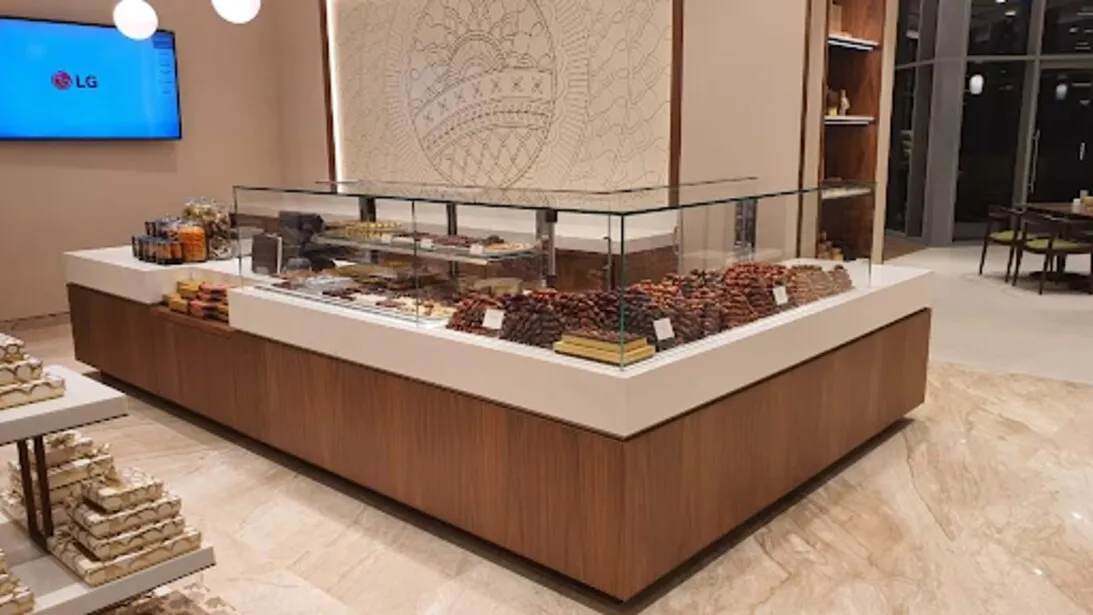
An L-Shaped Bakery Display Counter needs more than a corner measurement. Fix the internal and external corner geometry, usable display length, removable panels and compressor or controller access before fabrication.
Plan electrical supply, drainage, refrigeration piping and any remote-condensing-unit connection with the corner orientation; reversing it later can put the service panel against a wall or expose cables through the customer-facing section.
A self-contained Commercial Bakery Display Counter adds condenser heat and noise to the sales area, so its ventilation must remain unobstructed. A remote system moves that burden elsewhere but adds piping, controls, commissioning and service responsibility; compare total installed load, not cabinet price alone.
Calculate Usable Capacity and Separate Product Temperatures
Count the trays, cakes or pastry boxes you expect to sell during the busiest 60-minute period, then add the quantity needed before the next practical replenishment. Size the Commercial Bakery Display Counter by usable shelf area, not its outside length: subtract the service gap, corner dead space, supports and clearance between products.
Keep 20–30% of usable space free so staff can replenish without crowding or hiding labels.
Base the calculation on these figures:
- Product units per tray and trays per shelf
- Shelf width and depth that each product actually needs
- Peak-hour sales plus the replenishment interval
- Reserve space for seasonal items, display height and air circulation
Classify every recipe before choosing the cabinet. Formulation matters: a dry cake may be ambient, while a similar-looking cake with fresh cream needs refrigeration.
| Product condition | Examples | Display requirement |
|---|---|---|
| Ambient | Unfilled bread, dry cakes, some pastries | Dry bakery display at room temperature; protect from dust, heat and direct sun |
| Chilled | Cream-filled pastries, custards, cheesecakes, cream pies, cut dairy or egg products | Refrigerated display holding the product at 5°C (41°F) or below |
| Separate zone | Warm bread beside cream pastries, or products with conflicting humidity needs | Separate counters or temperature zones; do not combine incompatible duties |
A display case holds product that is already safe and chilled; it is not a rapid cooler. Cooling under the FDA Food Code means 57°C to 21°C within two hours, then to 5°C within six hours total.
Ask the supplier to state holding performance separately from blast-chilling capability, and measure product temperature at the warmest loading position.
Compare Refrigeration, Glass, Lighting and Construction Specifications
The decisive specification is product duty: a dry bakery display, refrigerated display or heated display. Unfilled bread and many dry cakes suit ambient holding, while cream pastries, custards, cheesecakes, cream pies and products containing cut dairy or egg need controlled cold storage under the formulation and local food-safety rules.
| Duty | Required specification | Main failure if mismatched |
|---|---|---|
| Dry | Ambient cabinet, sealed dust-resistant glazing, stable shelving | Refrigerating bread accelerates staling |
| Refrigerated | Stated holding range, usually 2–5°C, insulated glass, door seals, drainage and airflow | Warm spots shorten shelf life and can compromise TCS food safety |
| Heated | Controlled heat range, thermostat, humidity management and separate compartment | Dry heat makes bread hard and damages cream products |
A refrigerated Commercial Bakery Display Counter must hold already chilled food, not rapidly cool it. Ask the supplier to state holding performance separately from chilling capacity; the FDA Food Code cooling benchmark is 57°C to 21°C within two hours and 57°C to 5°C within six hours.
Choose self-contained refrigeration only after checking condenser ventilation, heat rejection and noise in the sales area. Remote refrigeration moves heat elsewhere but adds piping, controls, commissioning and service obligations, so compare total installed load rather than cabinet price alone.
LED lighting reduces compartment heat compared with older fluorescent systems; check its location, replaceability, ingress protection and driver position.
For an L-Shaped Bakery Display Counter, confirm the corner’s electrical supply, drainage, ventilation and remote-unit connections before fabrication. Specify stainless-steel work surfaces, closed-cell insulation, corrosion-resistant fasteners and accessible service panels; humid air exposes weak seals and poor drainage quickly.
Design the Daily Workflow and Cleaning Routine Before Buying
A counter that looks spacious can still fail at the busiest moment if staff cannot reach trays, packaging or the sink without crossing the customer queue. Draw the work sequence before approving the case.
1. Load products from the rear or service side, not through the customer opening. Keep spare trays and tongs within reach, and leave a clear route to the refrigerator so staff do not carry uncovered food across the sales area.
2. Serve with dedicated tongs, paper or gloves for each product group. Cream-filled pastries, custards, cheesecakes, cream pies and products containing cut dairy or egg need controlled cold holding under the formulation and local food-safety rules; keep refrigerated products at 5°C (41°F) or below.
3. Treat the case as a holding unit, not a rapid chiller. Cool hot food separately using the FDA Food Code benchmark—57°C to 21°C within two hours, then to 5°C within six hours total—before loading it.
4. Replenish in small batches from a labelled backup shelf or refrigerator. An L-Shaped Bakery Display Counter needs special checking at its inside corner: staff must reach the trays, and the corner must not block packing space, service access or the queue.
5. Write the cleaning route into the quotation: removable trays, accessible glass joints, drain access, washable seals and a service panel that opens without moving the counter. Schedule product removal, crumb clearing, washing, sanitising and temperature checks separately; record each completed task.
Test the warmest loading position, usually near the front or top of an open case, with a calibrated probe. An advertised air temperature does not prove that the product is safe.
Test the Footprint and Question the Supplier Before Ordering
Do not approve the drawing until the counter fits the room on paper and the service team can reach every panel. For an L-Shaped Bakery Display Counter, confirm the corner orientation before fabrication; reversing it can trap the service panel against a wall or force pipes and cables through the customer-facing side.
1. On the drawing, check wall lengths, counter depth, internal and external corner geometry, usable display length, aisle width, entrance clearance and sightlines. Mark removable panels, controller access, compressor access and glass joints. Show electrical points, refrigeration piping, drainage and any remote-condensing-unit connection.
2. At the site, measure the actual walls, corner squareness, ceiling height, doorway width and delivery route. Mark queue positions, staff paths and the location of sockets, drains and ventilation openings. A self-contained Commercial Bakery Display Counter needs clear airflow because it releases condenser heat and noise into the sales area.
3. In the quotation, require separate duties for dry, refrigerated and heated displays. Ask for product holding at 5°C (41°F) or below, accessible temperature monitoring and test results at the warmest loading position.
Confirm that the case holds chilled food rather than rapidly cooling it; cooling means 57°C to 21°C within two hours and 57°C to 5°C within six hours.
Ask Vinaayak Enterprises to state total installed load, remote-system controls, commissioning, service responsibility and corner access, not only the cabinet price. Reject a quote that omits these details.
Related products
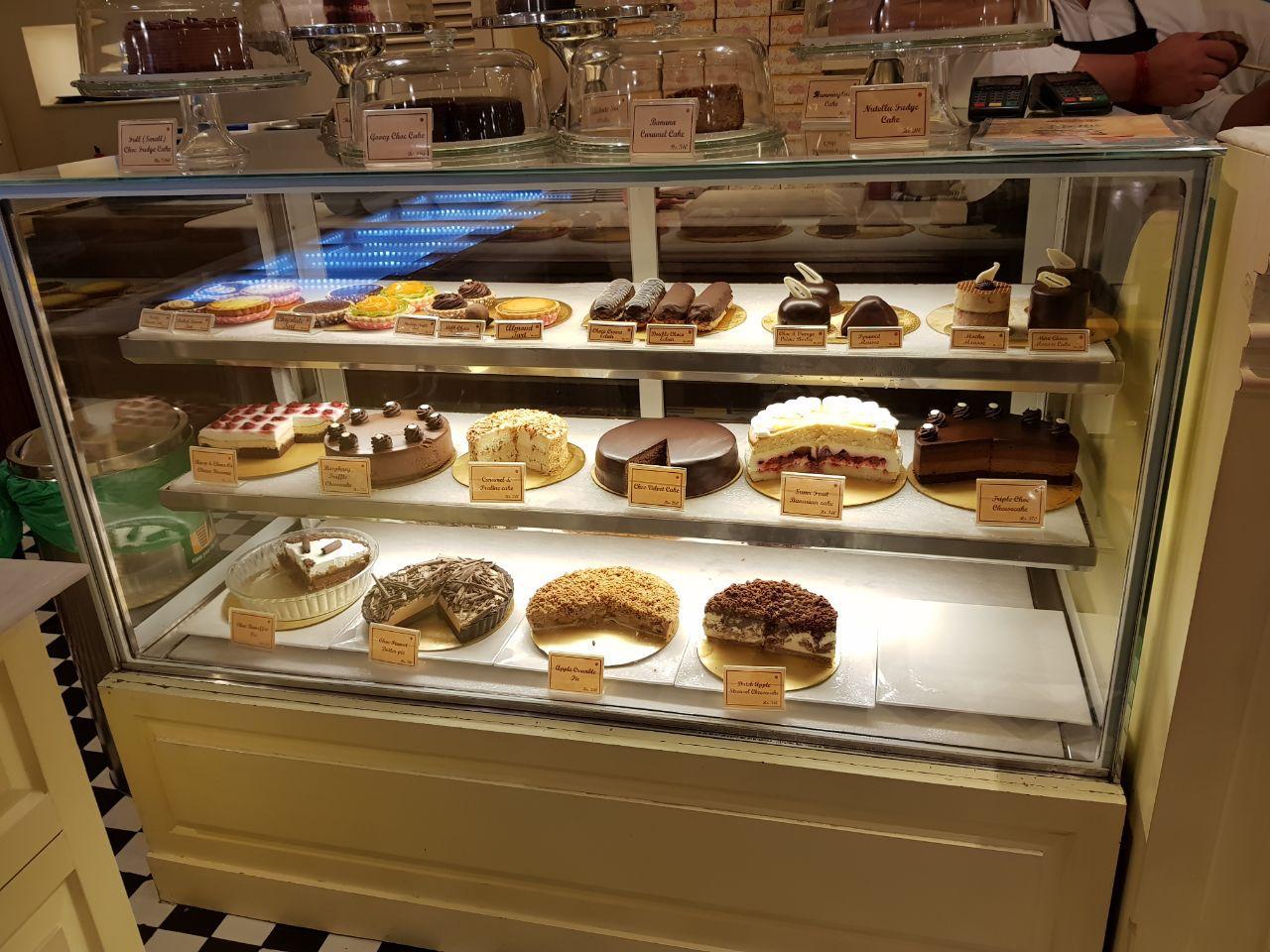 | Bakery, Cake & Confectionery Displays Commercial Bakery Display Counter Vinaayak Enterprises Commercial Bakery Display Counter is designed for bakeries, pastry shops, cafés, hotels, restaurants and confectionery outlets... View product → |
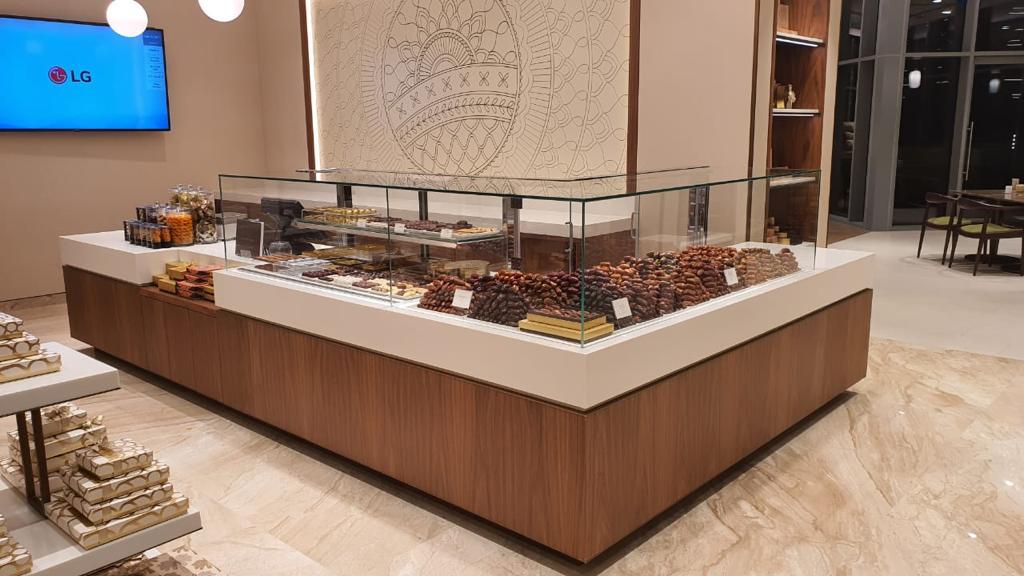 | Bakery, Cake & Confectionery Displays L-Shaped Bakery Display Counter Vinaayak Enterprises L-Shaped Bakery Display Counter is designed for bakeries, cake shops, cafés, hotels, restaurants and confectionery stores that... View product → |
Frequently asked questions
When is an L-shaped bakery display counter a good choice?
Choose an L-shaped counter when it fits the shop’s traffic pattern, creates a clear customer path and supports service from the available sides.
How do you calculate a bakery display counter’s usable capacity?
Measure the actual shelf lengths and depths, then deduct space needed for product separation, labels, trays, air circulation and staff access.
How should bakery products be separated by temperature?
Keep chilled cakes, cream pastries and dairy-filled products in refrigerated sections, while bread and dry pastries use ambient display space.
What should you compare in commercial bakery display counters?
Compare refrigeration temperature control, glass visibility, lighting, shelf adjustment, construction materials, insulation, access panels and serviceability.
What should you test before ordering a bakery display counter?
Mark the counter footprint on the floor, check queue and staff movement, confirm door clearances, and ask the supplier for power, dimensions and maintenance details.
Keywords