A kitchen hood can move its rated airflow and still spill smoke, grease or steam into the room when the canopy, appliance duty, replacement air and duct route do not work as one system. You will be able to classify the exhaust problem, estimate the design airflow, specify hood dimensions, test capture on site and identify the details that belong in a safe equipment quotation.
Key takeaways
- Classify steam, grease, smoke and heat before selecting a hood.
- Calculate airflow from appliance duty, hood geometry and capture requirements.
- Protect hood capture by controlling make-up air and cross-drafts.
- Specify duct access, fire safety and structural supports before purchase.
Classify the plume before choosing the hood
A visible plume does not identify the hood. Boiling water produces steam; a fryer produces invisible grease particles mixed with heat and smoke, even when the exhaust looks clear.
| Process or plume | Matching hood | What to specify |
|---|---|---|
| Steamers, pasta boilers, kettles and dishwashers: vapour, heat and condensate | Commercial Vapour Exhaust Hood or condensate hood, normally Type II | Confirm the listed classification, condensate management and that no grease-laden vapour enters the system |
| Fryers, griddles, charbroilers, woks and open-flame ranges: smoke, heat and grease aerosol | Type I grease-exhaust canopy hood | Specify grease filters, a cleanable grease duct, access panels and fire-suppression coverage |
| Roasting, baking or sautéing: heat, odour and smoke; grease depends on the food and appliance | Type I hood when grease or smoke is produced; Type II only for heat and vapour without grease | Classify the actual cooking load, not just the appliance name |
| Coffee brewing, reheating and non-grease food preparation: heat, steam or odour | Type II vapour hood or dedicated odour-extraction system | Select filtration and discharge arrangements for the odour; do not treat it as grease exhaust |
“Commercial Vapour Exhaust Hood” is supplier terminology, not a universal code classification. Ask whether the proposed hood is listed or approved as Type I or Type II and whether grease-laden vapour is permitted.
Never place a Type II hood over a fryer, charbroiler or greasy griddle. The wrong choice can send combustible grease into a duct without the filtration, cleaning access or fire protection that the installation needs.
Calculate airflow from the appliance duty and hood geometry
Start with the appliance duty and hood arrangement, not the hood’s floor area. A reliable airflow estimate comes from the manufacturer’s tested or listed exhaust data for the actual appliance group, hood geometry and installation condition.
- Record the cooking duty: light vapour, moderate heat, or heavy grease and smoke. A fryer or charbroiler needs a different capture capacity from a steam-producing appliance.
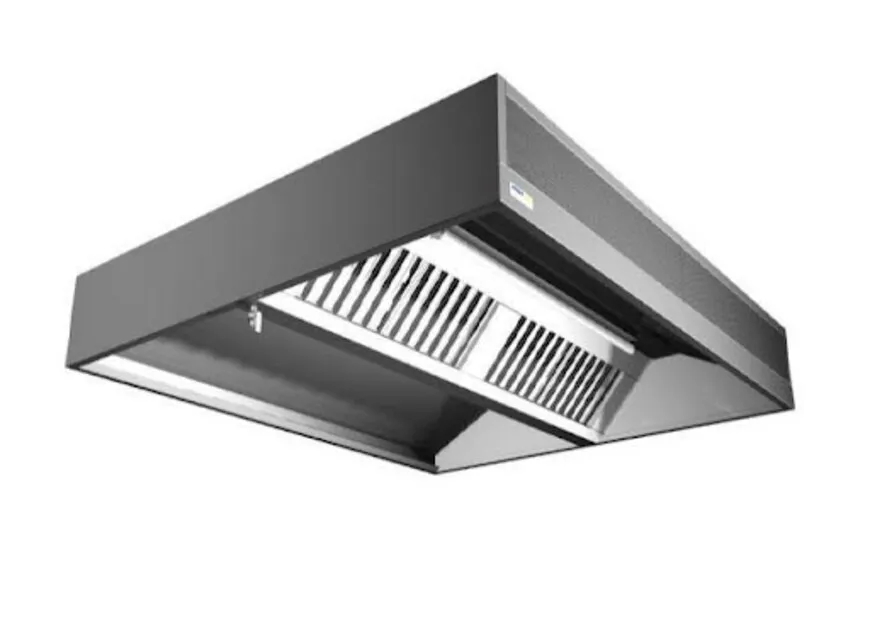
- Record the hood type and position: wall-mounted canopies benefit from the rear wall, while Island-Type Exhaust Hoods must contain the plume on all four sides.
- Confirm the hood length, depth, mounting height, end panels and overhang around the appliances. These dimensions alter the capture opening and the air volume needed.
- Obtain the listed airflow for that appliance duty and arrangement, in cubic metres per second or litres per second, then convert it: cubic metres per hour = cubic metres per second × 3,600.
- Add the listed airflow for separately controlled hood sections, rather than applying one rate to the entire canopy.
If no tested value matches the proposed layout, have a ventilation engineer size the system from plume behaviour and verify it with a capture-and-containment test. Do not invent a multiplier based on hood area; that approach can over-ventilate low-duty equipment while allowing a heavy grease plume to escape.
Demand-based controls can reduce airflow only after commissioning proves capture at each operating state. A timer or variable-speed drive that lowers the fan without that test leaves the fan running while grease-laden exhaust enters the kitchen.
Size the canopy and protect capture from cross-drafts
Extend the canopy at least 150 mm beyond the appliance on the front and open sides; use 300 mm at exposed ends for an island arrangement unless the hood manufacturer’s tested geometry specifies otherwise.
A narrow canopy can leave the rising plume outside the capture zone, especially when a door or supply diffuser creates a cross-draft.
| Hood type | Capture characteristic | Design consequence |
|---|---|---|
| Wall-mounted canopy hood | The wall blocks one side of the plume | Requires less airflow than an equivalent island hood, but still needs front and side overhang |
| Island-Type Exhaust Hood | Open on all four sides | Needs a larger capture-and-containment envelope, more airflow and protection from traffic, doors and air-conditioning jets |
| Type II vapour hood | Handles heat, steam and condensate | Do not use it over fryers, griddles, charbroilers or other grease-producing appliances |
Prove performance on site rather than accepting the nominal hood size. Run every appliance at its intended duty, switch on normal make-up air and air-conditioning, then repeat with nearby doors opening and staff traffic.
Use a smoke pencil or theatrical smoke to confirm that the plume enters the hood without spilling at the front, ends or corners; record exhaust and supply-air readings during the test. If smoke is pushed outward, rebalance the replacement air or remove the cross-draft before increasing fan speed.
Balance make-up air, pressure and the building services
Replacement air should enter through low-velocity, distributed supply points away from the hood face, not through a jet aimed at the cooking edge.
Supply air that strikes the plume, a high-velocity ceiling diffuser or an open door can push smoke and grease beyond capture; untempered air also creates drafts and adds heat or cold to the work area.
Keep the kitchen slightly negative to adjacent clean areas, but do not let exhaust create excessive pressure difference. Excess negative pressure makes doors hard to open, draws dusty outdoor air through cracks, pulls odours into neighbouring rooms and can starve gas burners of combustion air.
Confirm pressure with the exhaust, make-up air, air-conditioning and other building fans running together—not from the exhaust fan’s nameplate alone.
Set diffuser locations and supply volume after checking appliance combustion and hood geometry. An Island-Type Exhaust Hood is exposed on all sides, so traffic, door movement and air-conditioning jets can defeat capture faster than they would at a wall-mounted hood.
A worktable, shelf or appliance added beneath the hood can redirect the plume and invalidate the tested arrangement.
Commission the system under actual operating conditions. Check:
- room pressure and door-opening behaviour;
- supply and exhaust airflow at grilles;
- smoke-plume capture during peak appliance duty;
- combustion stability for gas equipment;
- performance with doors, fans and adjacent exhaust systems operating.
For Delhi kitchens, place outdoor-air intakes away from exhaust discharge, vehicle emissions and refuse areas. Use accessible filters and record a replacement interval; loaded filters reduce make-up airflow and admit contaminated air into food-preparation spaces.
Specify the duct, fire-safety and support details before buying
Do not approve a supplier’s quotation until the hood, duct and support arrangement appears on one coordinated drawing. A polished stainless-steel finish cannot compensate for a grease duct that cannot be cleaned or a fire system that misses the appliances.
1. State the hood classification: Type I for fryers, griddles, charbroilers, open flame and other grease-producing equipment; Type II for heat, steam and condensate only. Require the listed or approved classification and confirm that grease-laden vapour is permitted.
2. Specify grease-removal devices, baffle or mesh filter details, airflow rating, filter access and drain provisions. Do not accept a Commercial Vapour Exhaust Hood as a Type I substitute without written confirmation.
3. Require grease duct construction, routing, shaft and ceiling-void clearances, exhaust-fan details and access panels at long runs, offsets, transitions and grease-collection points. Reference NFPA 96 for hood and duct construction, cleaning access, exhaust fans and automatic fire-extinguishing systems.
4. Show fire-suppression nozzles over every appliance, fuel shut-off interfaces and manual pull-station locations. Coordinate these with appliance clearances; moving equipment after installation can leave coverage gaps.
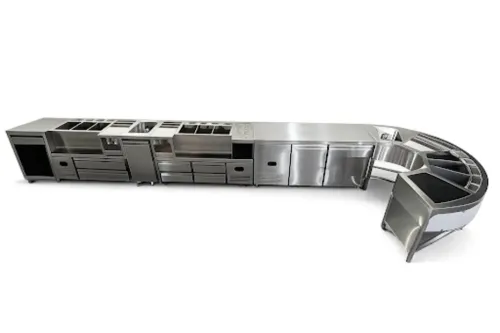
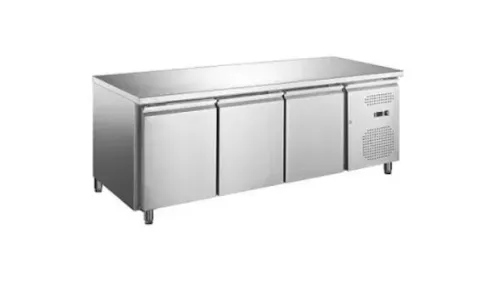
5. For an Exhaust Hood Worktable with Bracing, record static load, vibration, anchorage, corrosion resistance, cleanable joints and filter-removal clearance. Keep bracing out of the capture opening and loading path, and verify that equipment below the table does not alter the plume or require a revised listed arrangement.
Vinaayak Enterprises can be compared against other suppliers using this same drawing-based checklist, rather than choosing from a hood photograph alone. Insist on maintenance access and commissioning documents before purchase.
Related products
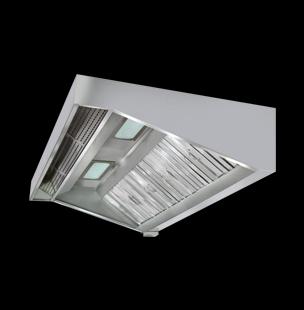 | Commercial Exhaust & Ventilation Stainless Steel Exhaust Hood with Fresh Air Grilles Vinaayak Enterprises Stainless Steel Exhaust Hood with Fresh Air Grilles is designed for commercial kitchens that require both effective exhaust... View product → |
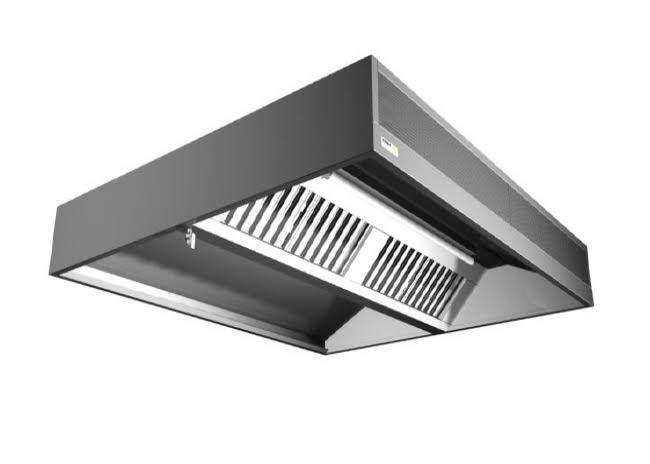 | Commercial Exhaust & Ventilation Vinaayak Enterprises Island-Type Exhaust Hood is designed for commercial kitchens where cooking equipment is positioned in a central island... View product → |
Frequently asked questions
How do you choose the right exhaust hood for a commercial kitchen?
Classify the appliance plume first. Steam from boiling differs from grease, smoke and heat from fryers, grills and ranges, so the hood must match the duty.
How do you calculate commercial kitchen exhaust airflow?
Base the calculation on appliance duty, hood dimensions and the capture-and-containment needs of the cooking line rather than using one airflow figure for every hood.
How can you stop cross-drafts from disrupting hood capture?
Size the canopy to cover the appliance line, then control make-up air, doors, fans and nearby supply outlets that push the plume away from the hood.
What should you specify before buying a kitchen exhaust hood?
Confirm duct dimensions and access, grease-cleaning provisions, fire-safety interfaces, mounting details and structural supports, including bracing for an exhaust hood worktable.
Related products
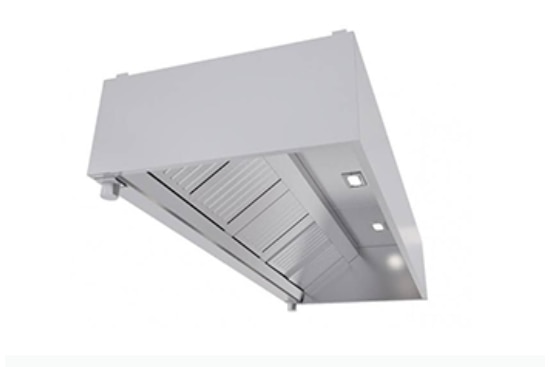
 | Commercial Exhaust & Ventilation Commercial Vapour Exhaust Hood Vinaayak Enterprises Commercial Vapour Exhaust Hood is designed for professional commercial kitchens to help remove grease-laden vapours, cooking... View product → |
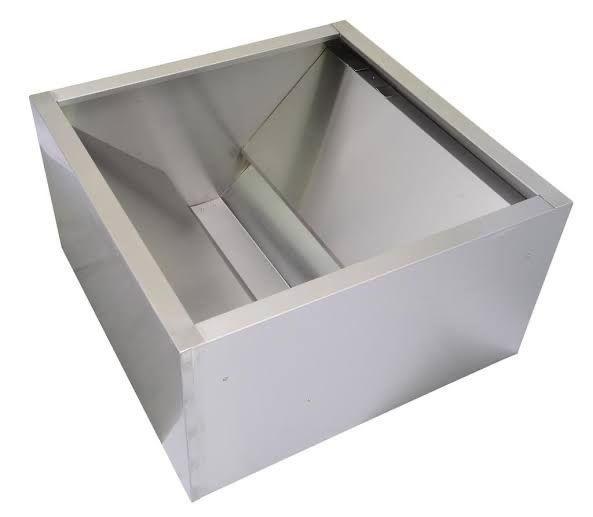
 | Commercial Exhaust & Ventilation Exhaust Hood Worktable with Bracing Vinaayak Enterprises Exhaust Hood Worktable with Bracing is designed for commercial kitchens that require a practical work surface integrated with a... View product → |
Keywords